


 |  |  |  |  |
|---|---|---|---|---|
 |  |  |  |  |
 |  |  |  |  |
 |  |  |  |
A MAGICAL LAND LIKE NO OTHER WHERE MAGNIFICENT SPECTACULAR BREATH TAKING VIEWS WITH UNIQUE WEATHER CONDITIONS THAT MAKES YOU FEEL YOU LIVE IN A PARADISE
Sri Lanka

BIODIVERSITY OF SRI LANKA
Sri Lanka is one of the smallest but biologically diverse countries in Asia. Consequently, it is recognized as a biodiversity hotspot of global and national importance. Its varied climate and topographical conditions have given rise to this rich species diversity, believed to be the highest in Asia in terms of unit land area.
Many of the species are endemic, a reflection of the island's separation from the Indian subcontinent since the late Mesozoic. This is especially relevant for mammals, amphibians, reptiles, and flowering plants. We can broadly categorize these species into forest, grassland, aquatic, coastal, marine, and cultivated ecosystems. The diversity of ecosystems in the country has resulted in a host of habitats, which contain high genetic diversity. There is a wide range of ecosystem diversity on the island. The major natural ecosystems in the country are forests, grasslands, inland wetlands, and coastal and marine ecosystems. It also includes agricultural ecosystems.
The environment activist group Conservation International (CI) has identified Sri Lanka as one of the world's 25 biodiversity hot spots. Sri Lanka, the island in the Indian Ocean, accounts for 2,180 plant species that are unique to each hot spot. Sri Lanka's tropical rainforest ecosystem is considered an area that is disturbed by human activity but still exceptionally rich in animal and plant species found nowhere else.


RAINFORESTS AND CENTRAL HIGHLANDS OF SRI LANKA

Adam's Peak or often used Sri Pada is derived from Sanskrit, used by the Sinhalese people in a religious context; this name also has meaning in Pāli, and may be translated roughly as "the sacred foot". It refers to the footprint-shaped mark at the summit, which is believed by Buddhists to be that of the Buddha. Christian and Islamic traditions assert that it is the footprint of Adam, left when first setting foot on Earth after having been cast out of paradise, giving it the name "Adam's Peak".
Go to link
Sinharaja Forest Reserve is a national park and a biodiversity hotspot in Sri Lanka. It is of international significance and has been designated a Biosphere Reserve and World Heritage Site by UNESCO. The hilly virgin rainforest, part of the Sri Lanka lowland rain forests ecoregion, was saved from the worst of commercial logging by its inaccessibility, and was designated a World Biosphere Reserve in 1978 and a World Heritage Site in 1988. The reserve's name translates as Lion Kingdom.
Go to link
The Knuckles Mountain Range lies in central Sri Lanka, in the Districts of Matale and Kandy. The range takes its name from a series of recumbent folds and peaks in the west of the massif which resemble the knuckles of clenched fist when viewed from certain locations in the Kandy District. Whilst this name was assigned by early British surveyors, the Sinhalese residents have traditionally referred to the area as Dumbara Kanduvetiya meaning mist-laden mountain range (Cooray, 1984).
Go to link
Horton Plains National Park in Ohiya is a protected area in the central highlands of Sri Lanka and is covered by montane grassland and cloud forest. This plateau at an altitude of 2,100–2,300 metres (6,900–7,500 ft) is rich in biodiversity and many species found here are endemic to the region. This region was designated a national park in 1988. It is also a popular tourist destination.
Go to linkNATIONAL PARKS IN SRI LANKA
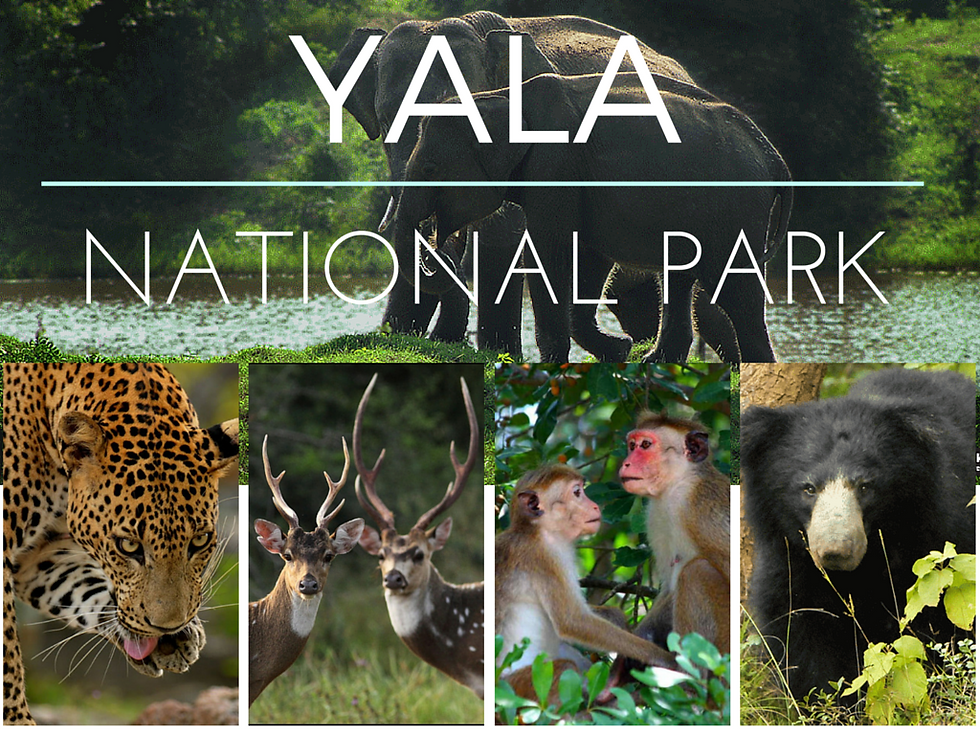
Yala National Park is the most visited and second largest national park in Sri Lanka. Yala was designated as a wildlife sanctuary in 1900, and, along with Wilpattu was one of the first two national parks in Sri Lanka, having been designated in 1938. The park is best known for its variety of wild animals. It is important for the conservation of Sri Lankan elephants, Sri Lankan leopards and aquatic birds.There are six national parks and three wildlife sanctuaries in the vicinity of Yala.
Go to link
Wilpattu National Park (Willu-pattu; Land of Lakes) is a park located on the island of Sri Lanka. The unique feature of this park is the existence of "Willus" (Natural lakes) - Natural, sand-rimmed water basins or depressions that fill with rainwater. Located in the Northwest coast lowland dry zone of Sri Lanka. The park is located 30 km west Anuradhapura and located 26 km north of Puttalam (approximately 180 km north of Colombo).
Go to link
Udawalawe National Park lies on the boundary of Sabaragamuwa and Uva Provinces, in Sri Lanka. The national park was created to provide a sanctuary for wild animals displaced by the construction of the Udawalawe Reservoir on the Walawe River, as well as to protect the catchment of the reservoir. The reserve covers 30,821 hectares (119.00 sq mi) of land area and was established on 30 June 1972. Before the designation of the national park.
Go to link
Minneriya National Park is a national park in North Central Province of Sri Lanka. The area was designated as a national park on 12 August 1997, having been originally declared as a wildlife sanctuary in 1938.[1] The reason for declaring the area as protected is to protect the catchment of Minneriya tank and the wildlife of the surrounding area. The tank is of historical importance, having been built by King Mahasen in third century AD.
Go to link